
Concrete Driveway Installation in Baldwin County, AL: What the Job Involves
A concrete driveway installation is mostly about what happens before the pour: grading and compacting the ground, setting a base, and planning where the water goes. Green Rock Solutions pours concrete driveways in Elberta, Foley and across Baldwin County. This page walks through the work in order and shows what to ask in a quote. It is part of our concrete services section.
Get a quote
How a concrete driveway installation works, in order
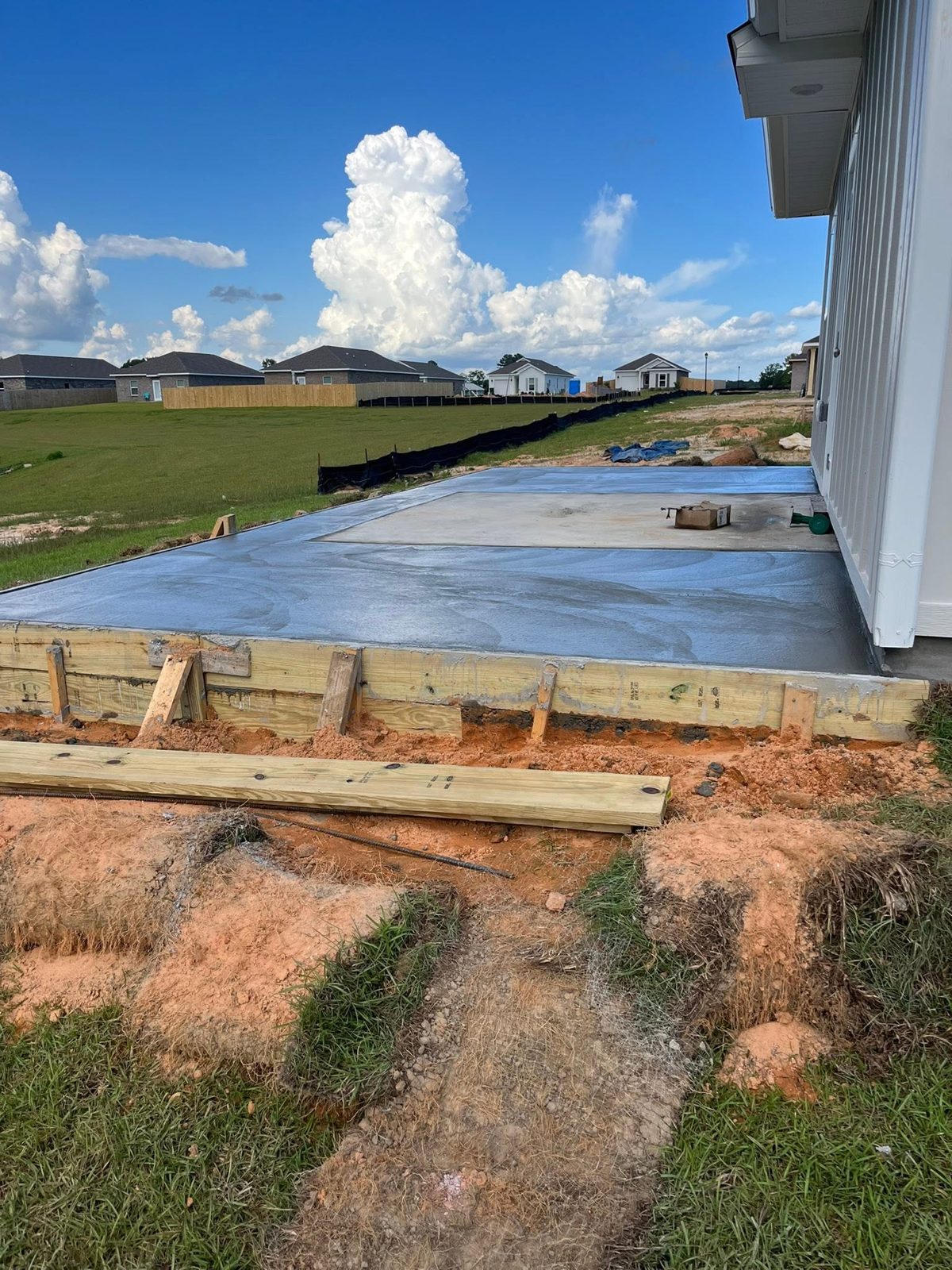
A concrete driveway installation runs in a fixed order: layout, excavation and grading, a compacted base, forms, reinforcement, the pour and finish, joints, then curing. The American Cement Association says the subgrade, the native soil under the pavement, "must be graded and compacted." The steps below describe what a crew does.
The county permit route, 811 and joints are covered on the concrete page, so this page stays on the install.
-
1
Layout and checks.
Size, shape and where the driveway meets the road.
-
2
Grade the subgrade.
The ground is shaped and compacted.
-
3
Place the base.
A layer between soil and slab. The American Cement Association says it "prevents the displacement of soil from underneath the pavement."
-
4
Set forms and reinforcement.
Forms hold the edges. Reinforcement is whatever the installer specifies.
-
5
Pour and finish.
The concrete goes in and the surface is finished.
-
6
Cut joints.
Planned lines where cracking is expected.
-
7
Cure.
The slab is kept moist and warm while it hardens.
Why the ground under the slab matters most in South Alabama
The American Concrete Pavement Association (ACPA) writes that the main goal for a concrete pavement foundation is "uniform support for the pavement that will prevail throughout its service life." It adds: "Above all other design concerns, uniformity is of utmost importance."
That is a pavement-engineering guide for professionals, not a homeowner checklist. It still explains the question worth asking.
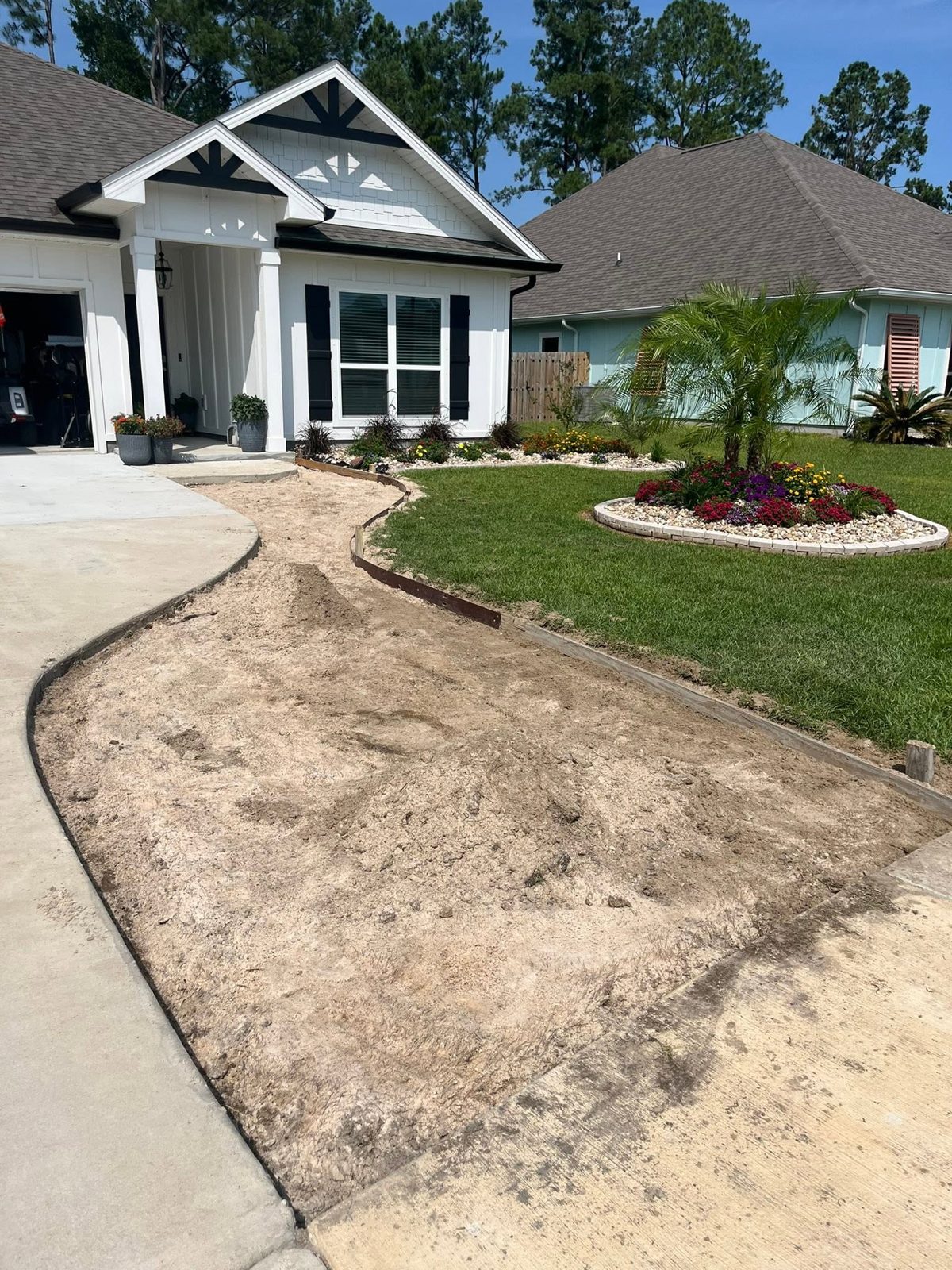
Alabama Extension says "Typical Coastal Plain soils have sandy topsoil and clayey subsoil." Ask the installer what is under your lot and how the base is built for it.
Thickness and reinforcement: what a county spec looks like
We did not find a published Baldwin County thickness for residential driveways. Another county's number is not a Baldwin rule, but it shows how specific a spec can be.
Indian River County, Florida, requires concrete driveways to be "a minimum of 6" thick, 3,000 psi fiber reinforced concrete on a properly graded and stabilized subgrade compacted to 98% maximum dry density." Its detail also calls for a thickened edge. Psi is the strength rating of the mix. Fiber reinforced means fibers are mixed into the concrete to help control cracking.
ACPA's pavement guide gives a minimum subbase of 4 in. for an unstabilized subbase. It is written for pavements, so treat it as background.
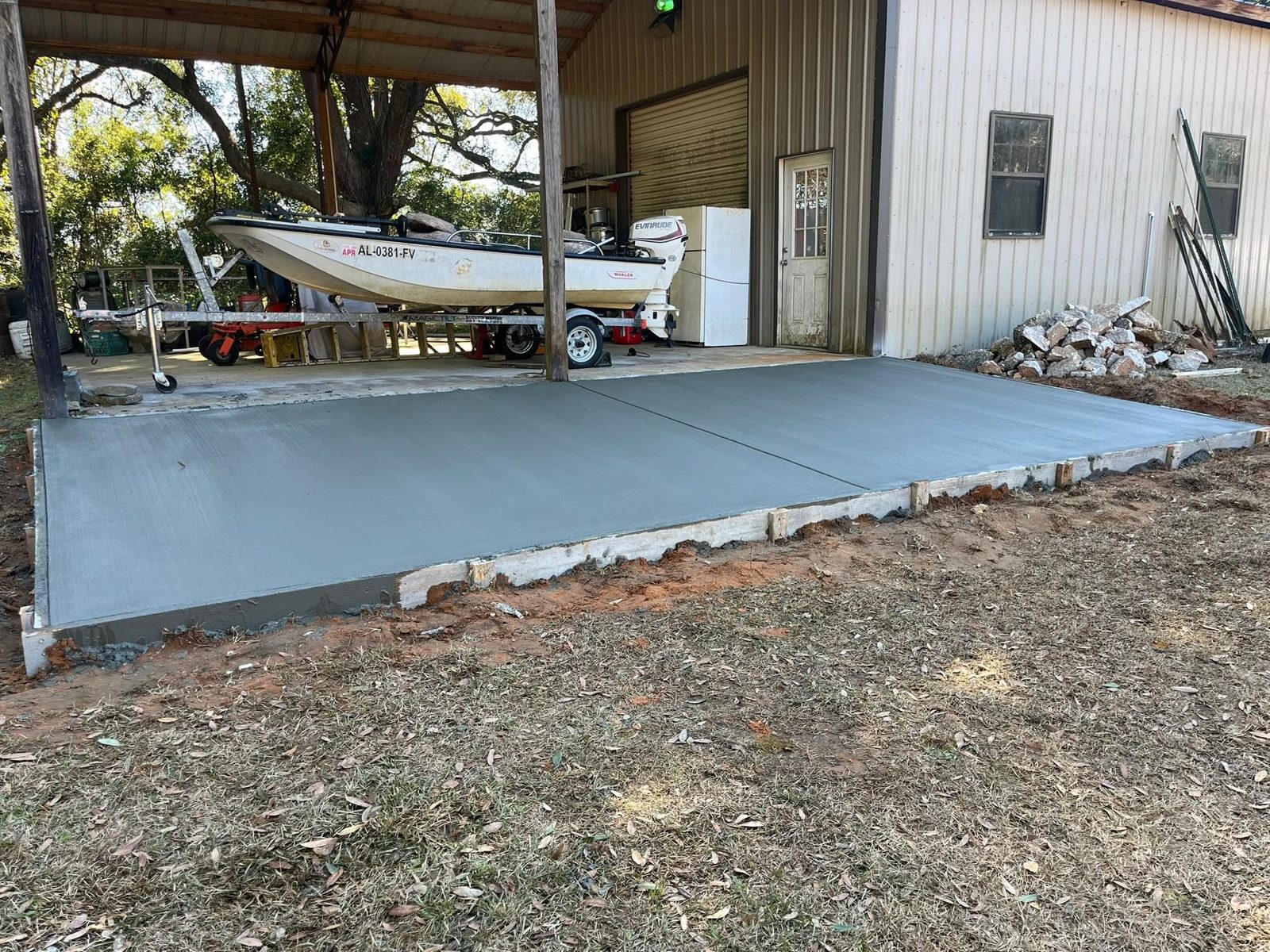
Before you sign, ask the installer to write down the slab thickness, the mix strength, the reinforcement and the base.
Drainage and where the water goes
ACPA warns against a base that traps water: "It is important not to build a supporting layer system that holds water underneath the pavement slabs."
At the street, the county's route matters. Baldwin County takes permit applications for "driveways, turnouts, and culverts on County-maintained roads" through its online portal. A culvert is a pipe that carries ditch water under a driveway.
Indian River County's spec shows the logic: the driveway follows the ditch contour unless a culvert is installed. Ask where the water from your driveway goes, and whether a culvert is part of the plan.
Curing: why a new driveway stays off limits
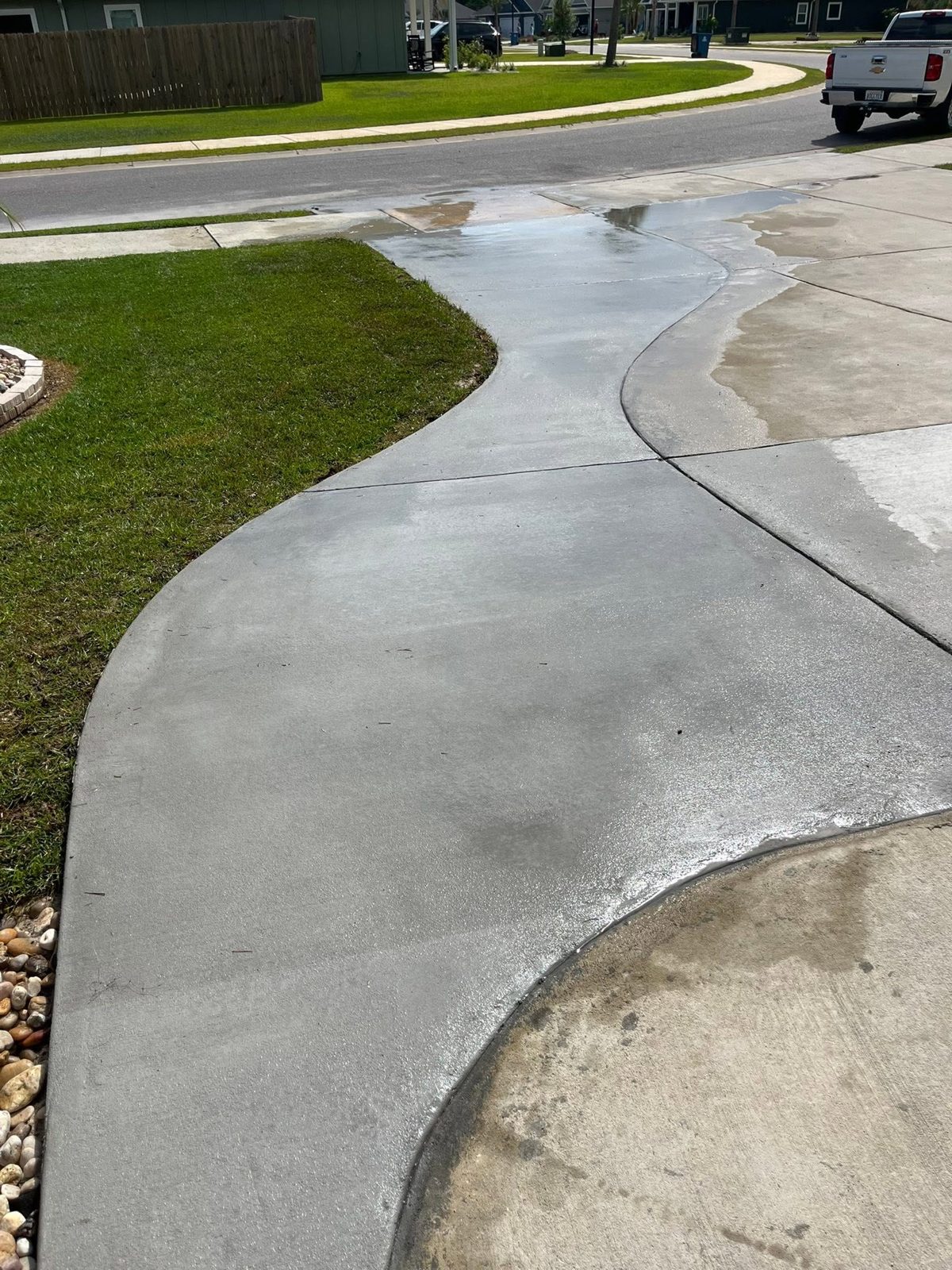
The National Ready Mixed Concrete Association (NRMCA) says curing "begins immediately after placement and finishing and should be continued for a sufficient period of time, typically 3 to 7 days."
Three more points from NRMCA's curing sheet:
- Temperature of placed concrete should stay above 50°F (10°C).
- In hot weather, a higher initial curing temperature gives "rapid strength gain and lower ultimate strengths."
- "Alternate wetting and drying is not an acceptable curing practice."
NRMCA gives no date for driving on a driveway, and we found no Alabama source for one. Your installer should tell you when it is ready for use.
What to ask an installer before you sign
- What slab thickness, mix strength and reinforcement are in the quote?
- What base goes under the slab, and how is the ground prepared?
- Where does the water go, and is a culvert involved?
- Which permits does the job need?
- How will the slab be cured, and when can it be used?
Who handles the permit?
It depends on the scope of the job. Sometimes Green Rock Solutions handles the permit and sometimes the homeowner does, so ask us when you request your estimate. County permit details for driveways on county-maintained roads are on our concrete page.
Concrete driveway questions
How thick should a concrete driveway be?
We found no Baldwin County number. One Florida county requires at least 6 in. of fiber reinforced, 3,000 psi concrete. Ask your installer for the thickness in writing and why.
How long does a new concrete driveway cure?
NRMCA says curing should continue for "typically 3 to 7 days." That is curing time, not a drive-on date. Ask your installer when it is ready.
Does a concrete driveway need a base?
The American Cement Association says the subgrade "must be graded and compacted" and the subbase prevents soil displacement. ACPA's pavement guide gives 4 in. as a minimum subbase for an unstabilized subbase.
Ready to plan your driveway?
A good driveway starts with the ground, the base and the drainage. Green Rock Solutions pours concrete driveways and patios in Elberta, Foley and Baldwin County. Request a quote and tell us the town and the rough size.
- Call
- (251) 496-0834
- Hours
- Monday to Friday, 9:00 AM to 5:00 PM
- Address
- 11194 County Road 83, Elberta, AL 36530
- Service area
- Elberta, Foley and Baldwin County, AL
Free estimates. No obligation.