
Stamped Concrete Patio: How the Pattern and Color Go In, and When Plain Concrete Is Better
A stamped concrete patio is a poured slab with a pattern pressed into it while the concrete is still soft, usually colored in the mix or on the surface. The look is real. So are the trade-offs: a sealer that can turn slick when wet, and upkeep nobody publishes a number for. This page covers both, so you can decide whether stamped is worth it before you ask for a quote.
Stamped concrete sits within our concrete services in Elberta, Foley and Baldwin County. The sources below are national trade-body and manufacturer documents. None of them is specific to Alabama, and we say so where it matters.
Get a quote
How does a stamped concrete patio get its pattern?
Stamped concrete gets its pattern from imprinting tools pressed into concrete that has set partway. The Portland Cement Association (PCA) says brick, cobblestone and tile finishes "can be impressed deeply into partially set concrete with special imprinting tools." The concrete is finished first, then stamped, and the stamping must finish before it hardens fully.
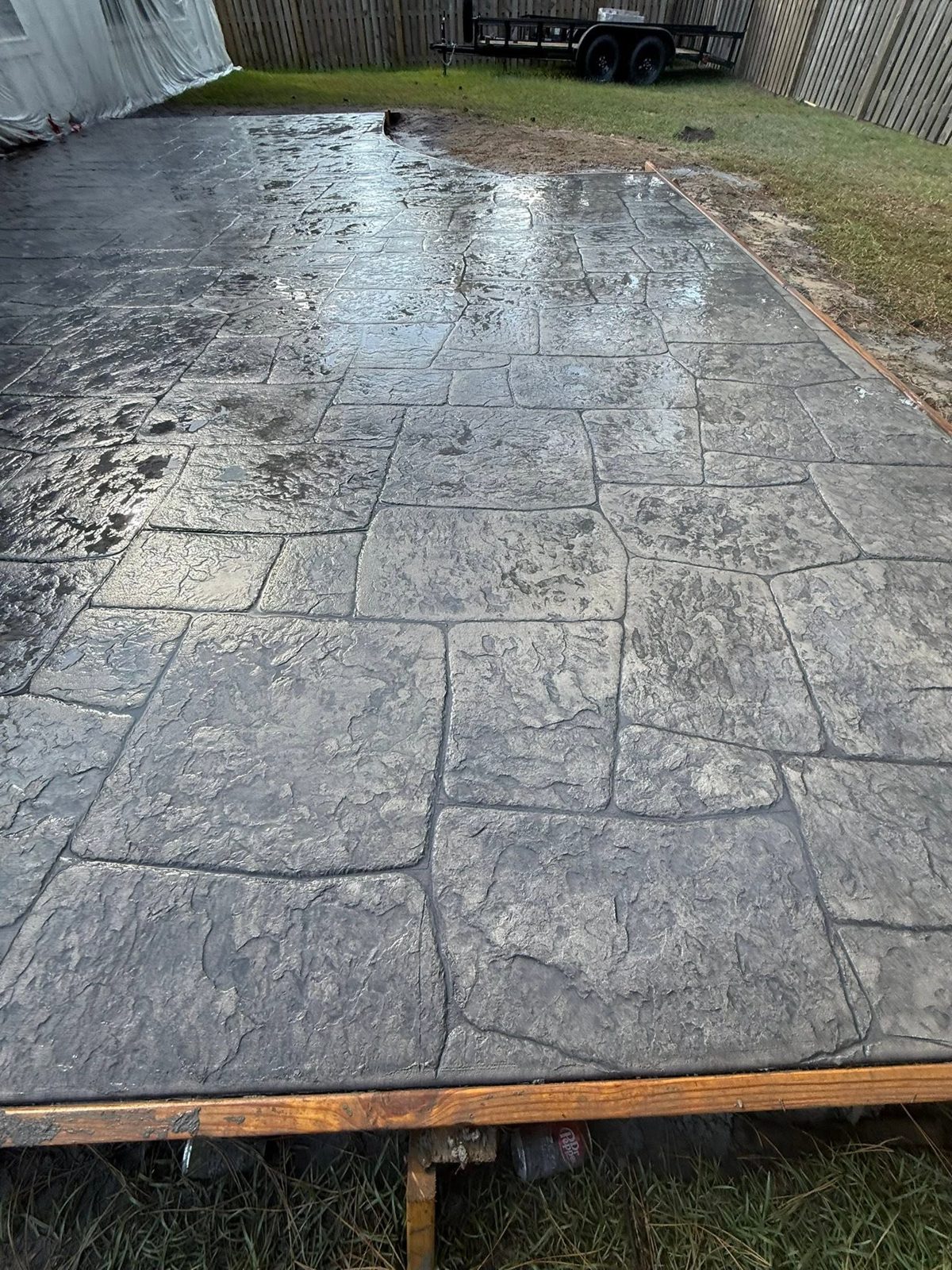
The Portland Cement Association's guide to finishing slabs with color and texture (2004) adds two details most gallery pages skip. The surface "should not be troweled more than once" before stamping. And "Timing is critical since all stamping must be completed before the concrete is fully hardened."
How the color gets in: integral color, color hardener and release agent
PCA says color comes one of two ways: "Integral color admixtures are added to the concrete or dry-shake coloring agents are applied to the surface to color the concrete." A third product, the release agent, keeps the stamps from sticking and can add a second shade.
Integral color
Pigment mixed through the concrete
Mixed in with the fresh concrete
Color hardener (dry-shake)
A dry powder worked into the top of the slab
Applied to the freshly screeded surface
Release agent
A barrier between stamp and concrete, sometimes tinted
Before stamping, as plastic sheet or powder
PCA's guide specification asks for pigment mixed "with sufficient mixing time to produce a consistent, streak free color." On the surface method it says dry-shake hardeners "shall be applied to the freshly screeded surface." Screeded means the slab has been struck off level.
On release, PCA notes the plastic sheet "minimizes the possibility of concrete sticking to the stamp and then tearing the surface," and that textured surfaces "may require the use of powdered release agents." Euclid Chemical's Increte Color Release is described as "Used as a stamp-tool release and secondary-color accent on plain or colored concrete." All of this happens in a short window on pour day. The base, joints and curing are the same as any slab, and they are covered on the concrete page.
What the sealer does, and what it costs you
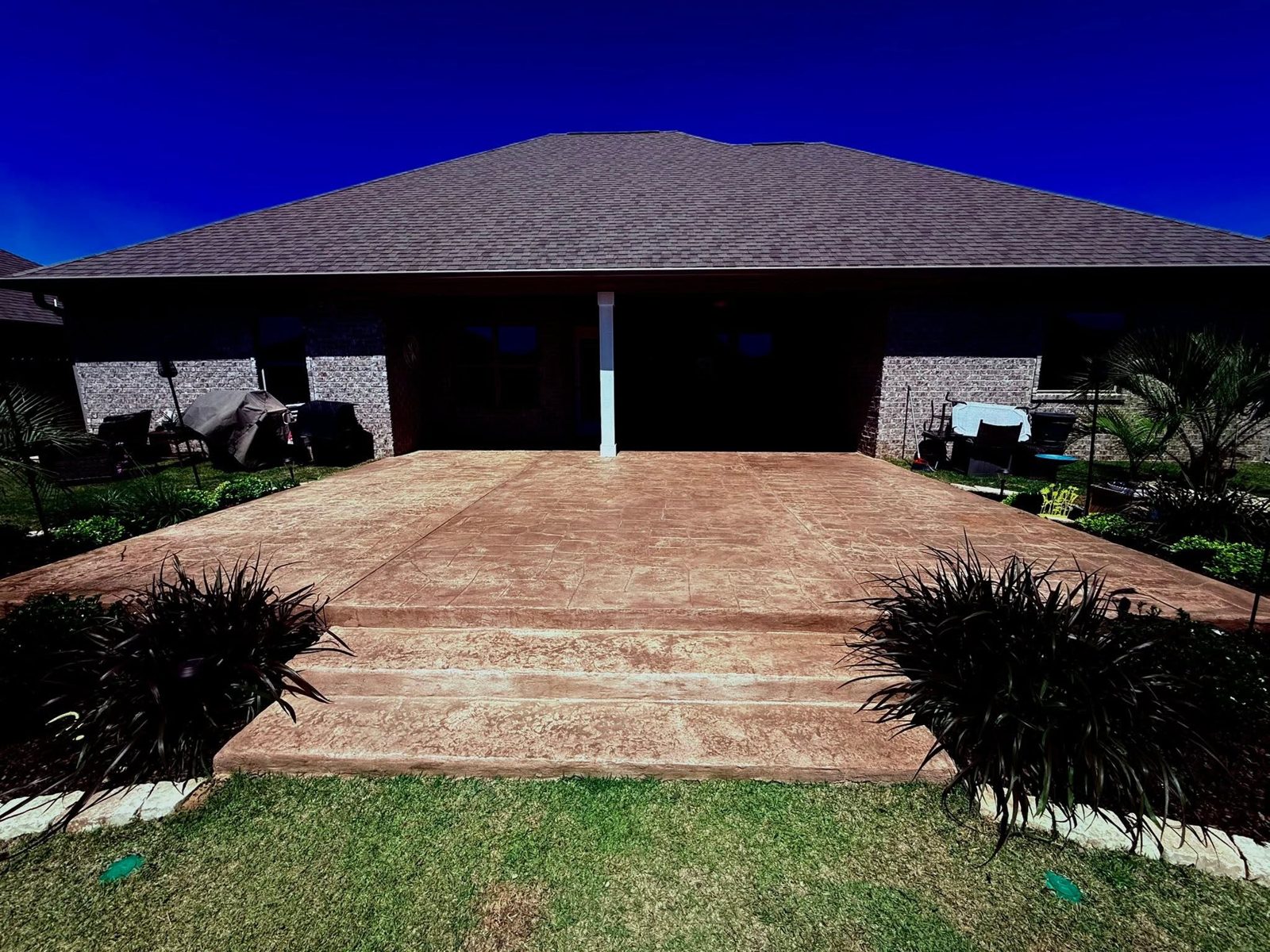
Sealing is optional in PCA's guide specification: "After the slab is completely dry, a clear, nonyellowing sealer" goes on. A sealer is a clear coating that sits on or in the surface.
Sealer makers give their own conditions. One data sheet, SaverSystems' MasonryDefender stamped concrete sealer (2018), says new concrete "should cure for a period of no less than 28 days" before sealing. That is one product's instruction, not a rule for every sealer.
Sealing has a cost beyond the coating. It can change how the surface feels under a wet foot.
Why stamped concrete can be slippery when wet
PCA is blunt about smooth concrete: "Smooth surfaces are slippery and hazardous when wet." Stamped concrete is textured, but the coating on it matters. A 2013 article in Concrete Decor magazine, "Fixing Slippery Stamped Concrete Near Pools", reports that when a stamped surface near a pool is slick, "a topical sealer, not the texture, is often the culprit."
The usual fix is a grit additive mixed into the sealer. Euclid's Ultra-Grip data sheet (2026) describes a "colorless, finely-graded, polypropylene non-slip additive for solvent-based sealers," and adds "Results may vary depending on coating, substrate and application techniques."
The magazine puts it plainly: "less slippery" does not mean slip-free. We found no independent wet-traction numbers for stamped patios, so we do not give one. If the patio is near a pool, a hose bib or a downspout, ask the installer what finish is planned for those wet zones.
Fading and upkeep: what the sources do not say
We found no published fade rate for stamped concrete in Alabama sun, and no reseal interval from a neutral source. Any contractor who quotes you years is quoting experience, not a standard, so ask what they base it on.
Here is what the documents do say. The MasonryDefender sheet lists "Protects Against Color Fade" as a product advantage, which is a manufacturer's claim and not test data. PCA adds one color caution: "Moist curing of color-pigmented concrete may increase the potential for efflorescence." Efflorescence is the white, powdery salt deposit that can show on concrete. Ask how a colored slab will be cured.
When broom-finish concrete is the better call
The National Ready Mixed Concrete Association (NRMCA) says exterior slabs are normally broom-textured: "texture the concrete surface after floating with a coarse or fine push-broom to give a non-slip surface." Its bulletin, CIP 14, also warns that "Decorative finishes need special procedures and experience."
That points to when plain is the better call, as a judgment from these sources and not a rule:
- The patio is wet often: near a pool, under a roof edge, or sloped toward drains.
- You want the lowest-upkeep surface and don't want to manage a sealer.
- You'd rather spend on a larger slab than on the pattern.
- You can't confirm the installer has stamped work to show you.
A broom-finish slab can still be colored and shaped. For a plain slab built the same way as a driveway, see our concrete driveway page. For patio ideas beyond concrete, see outdoor living.
What to ask a stamped concrete contractor before you sign
- Is the color integral, dry-shake hardener, or both?
- What release agent is used, and what accent color will it leave?
- What sealer, how many coats, and does it include a non-slip additive?
- How will wet areas be handled?
- When can the sealer go on, and who reseals it?
- Can I see a stamped patio you poured at least a year ago?
Stamped concrete patio questions
Is stamped concrete slippery?
It can be when wet. A 2013 Concrete Decor article says the topical sealer, not the texture, is often the cause, and that a grit additive makes a surface "less slippery," not slip-free. Ask about the finish in wet areas.
Do you have to seal stamped concrete?
PCA's guide specification lists the sealer as optional. One manufacturer says new concrete should cure at least 28 days before its sealer goes on. Ask what your installer recommends and why.
What is the difference between integral color and color hardener?
Integral color is mixed into the concrete. Color hardener is a dry powder applied to the freshly screeded surface. PCA describes both.
Ready to talk through a stamped patio?
Stamped concrete trades looks for upkeep and a slicker surface when wet. If you want to know whether Green Rock Solutions can pour one for you in Elberta, Foley or Baldwin County, request a quote and tell us the town and the rough size.
- Call
- (251) 496-0834
- Hours
- Monday to Friday, 9:00 AM to 5:00 PM
- Address
- 11194 County Road 83, Elberta, AL 36530
- Service area
- Elberta, Foley and Baldwin County, AL
Free estimates. No obligation.